


On April 9th, 2026, Professor ZHANG Han from Hong Kong Baptist University was invited by the Department of Management Science and Engineering to deliver a lecture titled The Empathy Trap: Reactance Against Empathic Chatbots in Customer Service to faculty and students of the School of Business. The lecture was hosted by Prof. LI Jia. Prof. LIU Xuan, Associate Prof. ZHANG Kaili, Dr. WU Xueqi, as well as some master’s and doctoral students attended the event.
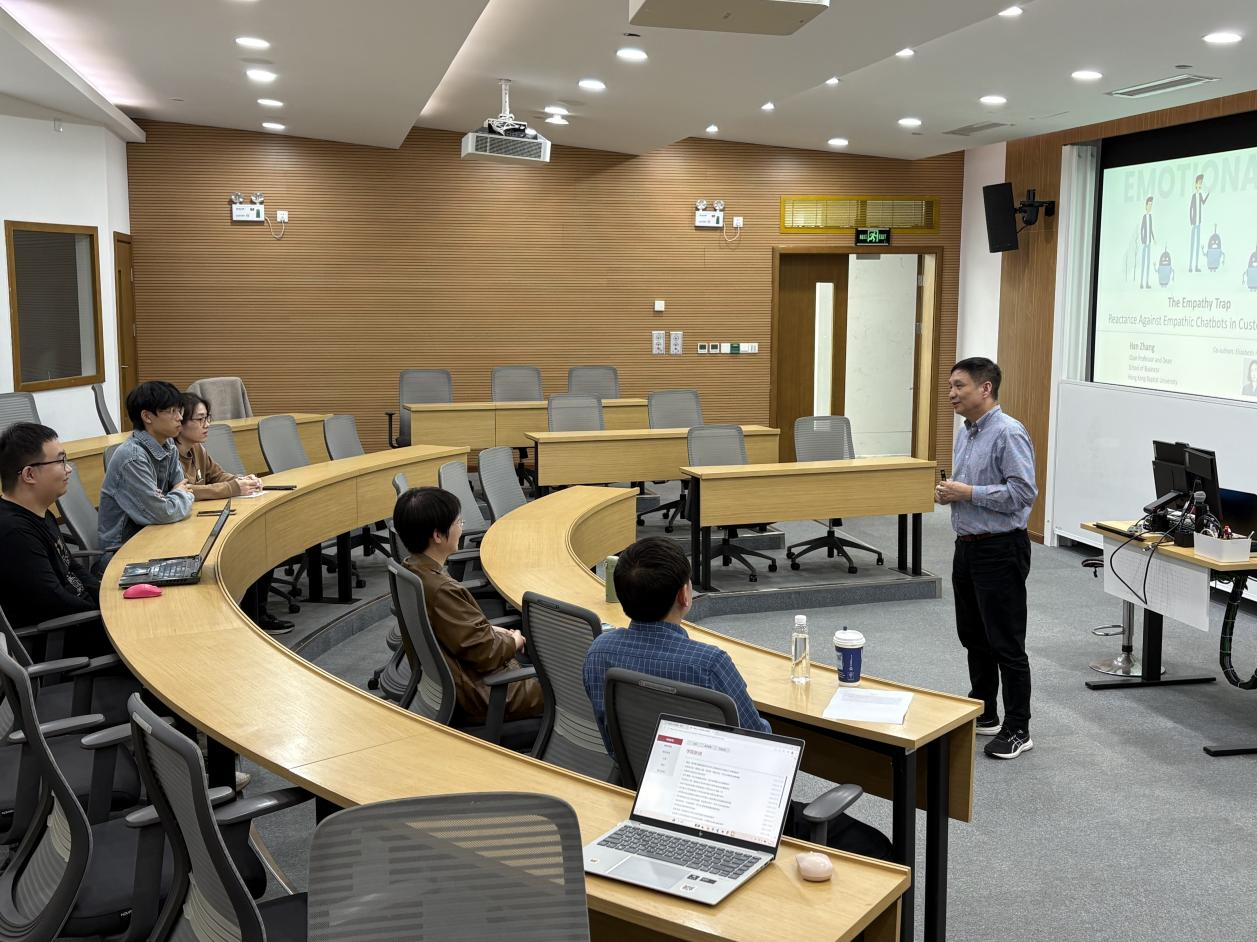
In his lecture, Prof.ZHANG shared the latest research findings of his team at the intersection of artificial intelligence (AI) and emotional response in customer service. With the rapid advancement of AI technologies, chatbots have developed preliminary capabilities for emotional perception and empathetic expression. In traditional customer service scenarios, empathy expressed by frontline staff is not only a core requirement of emotional labor but also widely regarded as an effective remedial strategy to repair customer relationships and alleviate negative emotions following service failures. However, when the subject of empathetic expression shifts from human employees to AI chatbots, its effects are far from a simple linear transfer, and the underlying influencing mechanisms remain to be explored in depth. The latest research by Professor ZHANG’s team focuses on this cutting-edge issue, investigating how and why empathetic expressions from AI chatbots exert significantly different impacts on customers’ service evaluations compared to human employees.Based on psychological reactance theory, Prof.ZHANG’s team proposed an innovative and disruptive research hypothesis: despite empathy being intended to soothe customers, empathetic responses from AI chatbots in the context of service failures may instead trigger customers’ psychological reactance. Such reactance stems from the unique nature of AI relative to humans—customers may believe that AI lacks genuine understanding and emotional capacity, thus perceiving AI’s empathetic expressions as programmed, insincere, or even manipulative interaction strategies. To validate this theory, the research team designed and conducted three rigorous laboratory experiments. By simulating strictly controlled service failure dialogue scenarios, the research confirmed that following service failures, empathetic expressions from AI chatbots significantly reduce customers’ overall service satisfaction by triggering psychological reactance as a key mediating pathway. The study further revealed the internal mechanism through which AI empathy induces customer psychological reactance, providing critical empirical boundaries for the design of emotional interaction in intelligent customer service systems.
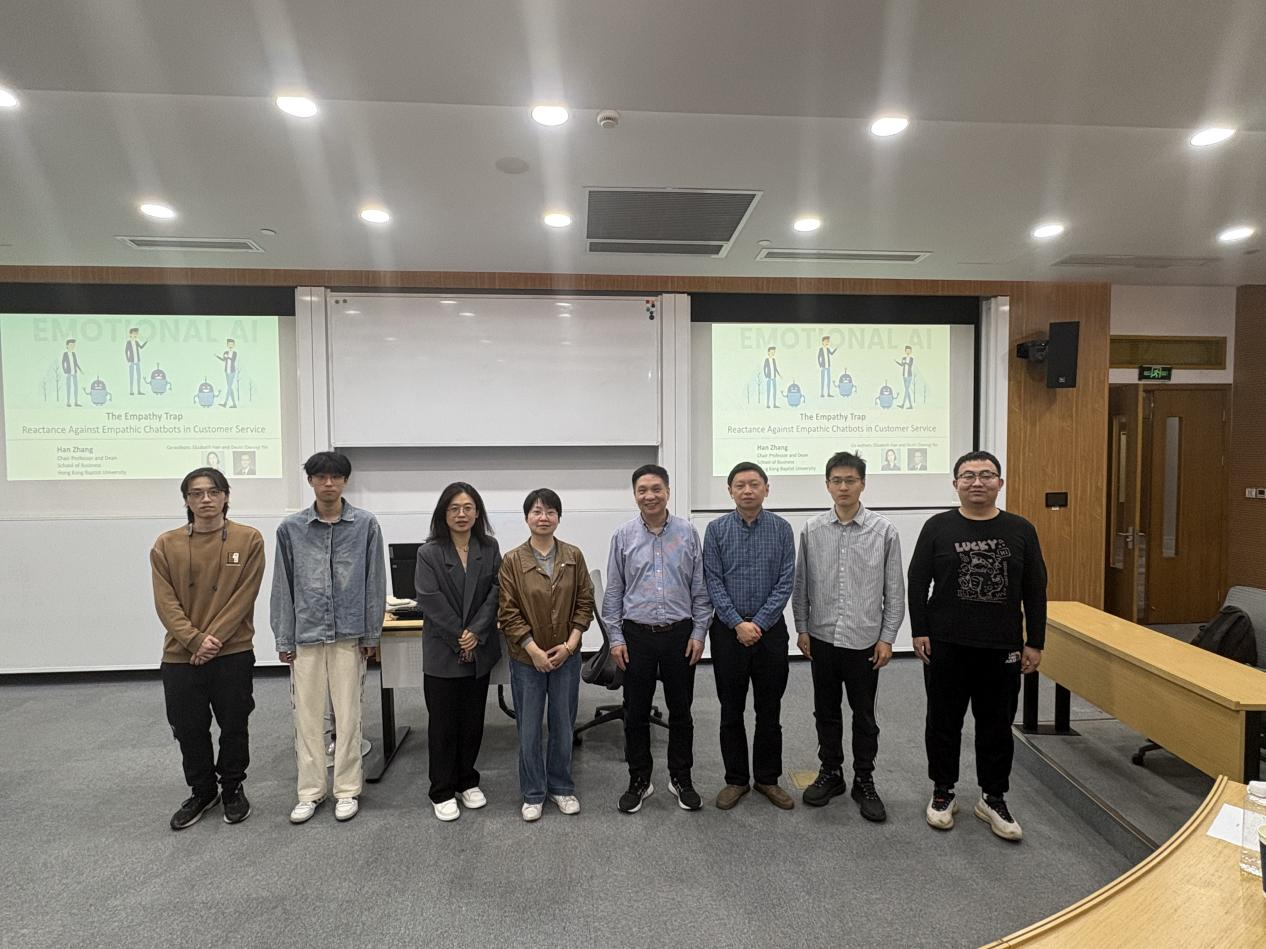
During the subsequent Q&A session, faculty and students engaged in lively discussions on the essential differences between “AI empathy” and “human empathy”. Regarding the extension of psychological reactance theory to human-computer interaction, Professor ZHANG shared his team’s research journey of identifying key psychological variables from subtle consumer feedback. In terms of experimental design, he elaborated on how to strictly control human-computer dialogue flows through scenario simulation experiments to isolate the net effects of variables. In addition, he had in-depth exchanges and guidance with young faculty and doctoral students on balancing theoretical rigor and external validity in commercial scenarios in interdisciplinary research.
About the Speaker
Prof.ZHANG Han is currently Dean of the School of Business and Chair Professor of Information Systems at Hong Kong Baptist University. He previously served as a tenured Professor of Information Technology Management and Steven A. Denning Chair in Technology and Management at the Scheller College of Business, Georgia Institute of Technology. He earned his Ph.D. in Information Systems from the University of Texas at Austin. His research focuses on online trust and reputation, online word-of-mouth, human-computer interaction, and online healthcare. His work has been published in top international journals including MIS Quarterly, Information Systems Research, Journal of Marketing Research, and Production and Operations Management. His research findings have been featured in special reports by China’s China Business News and the U.S. Wall Street Journal.
Prof.ZHANG currently serves as Editor-in-Chief of the renowned international academic journal Information & Management, and Senior Editor of MIS Quarterly and Journal of Information Systems and E-Business Management. As a co-founder, he launched the China Summer Workshop on Information Management (CSWIM) in 2007. He received the AIS (Association for Information Systems) Fellow Award in 2023 and the INFORMS ISS (Information Systems Society) Distinguished Fellow Award in 2025. He is the first Chinese scholar in the international information systems field to receive both the AIS Fellow and INFORMS ISS Distinguished Fellow honors.