Academic
The 50th "Business School Serial Lecture "
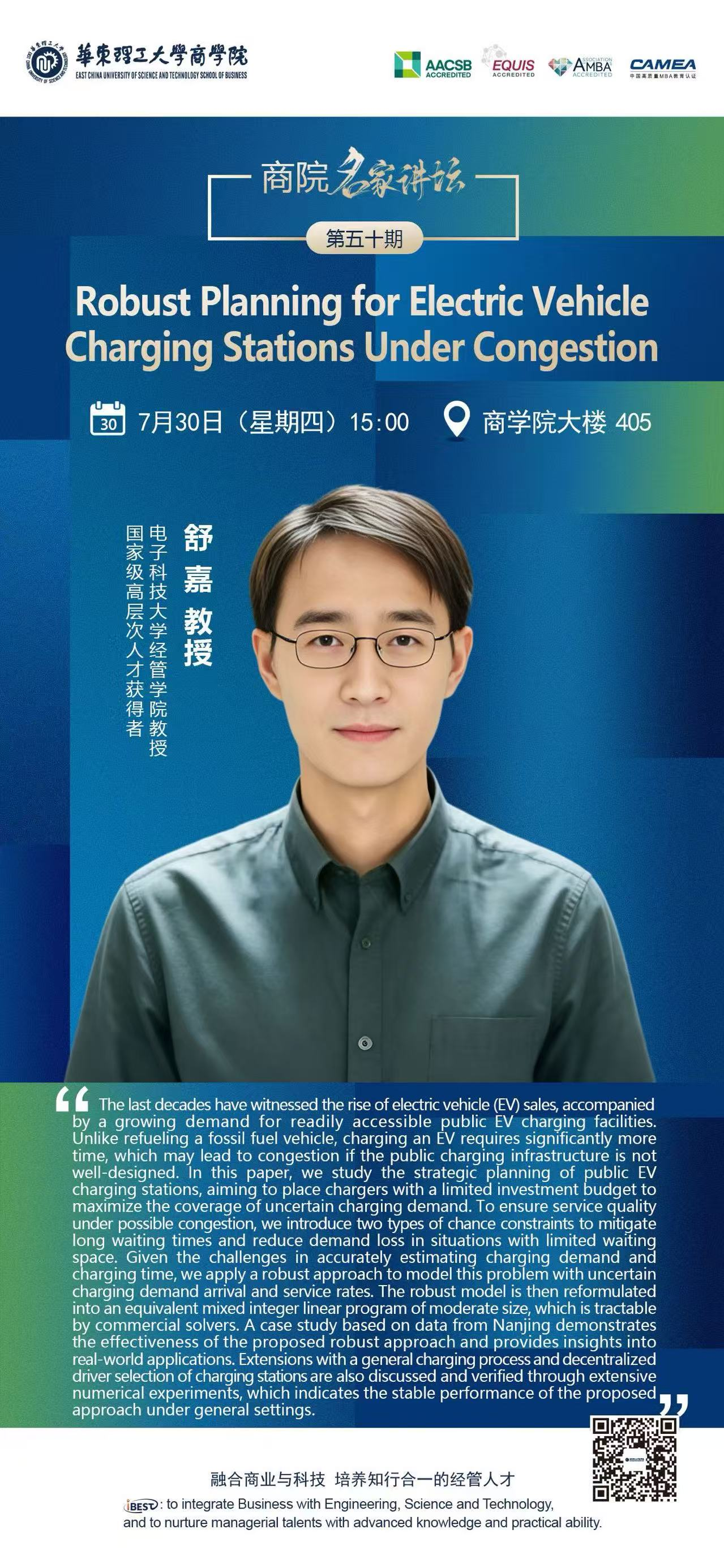
Title: Robust Planning for Electric Vehicle Charging Stations under Congestion
Speaker: Jia Shu
Time: July 30th, 2026 (Thursday) 15:00
Venue: 405, School of Business, East China University of Science and Technology
Organizer: School of Business, East China University of Science and Technology
Guest Bio:
Professor Jia Shu is a Professor at the School of Management and Economics, University of Electronic Science and Technology of China, and a recipient of the National High-Level Talent Award. His research focuses on logistics and supply chain management. He has led research projects including the National Natural Science Foundation Young Scientist Program (Category A), Key Program, and Major Project. His research has been published in international journals such as Operations Research, INFORMS Journal on Computing, Transportation Science, Naval Research Logistics, and IISE Transactions.
Synopsis:
The last decades have witnessed the rise of electric vehicle (EV) sales, accompanied by a growing demand for readily accessible public EV charging facilities. Unlike refueling a fossil fuel vehicle, charging an EV requires significantly more time, which may lead to congestion if the public charging infrastructure is not well-designed. In this paper, we study the strategic planning of public EV charging stations, aiming to place chargers with a limited investment budget to maximize the coverage of uncertain charging demand. To ensure service quality under possible congestion, we introduce two types of chance constraints to mitigate long waiting times and reduce demand loss in situations with limited waiting space. Given the challenges in accurately estimating charging demand and charging time, we apply a robust approach to model this problem with uncertain service rates. The robust model is then reformulated into an equivalent mixed integer linear program of moderate size, which is tractable by commercial solvers. A case study based on data from Nanjing demonstrates the effectiveness of the proposed robust approach and provides insights into real-world applications. Extensions with a general charging process and decentralized driver selection of charging stations are also discussed and verified through extensive numerical experiments, which indicates the stable performance of the proposed approach under general settings.