Academic
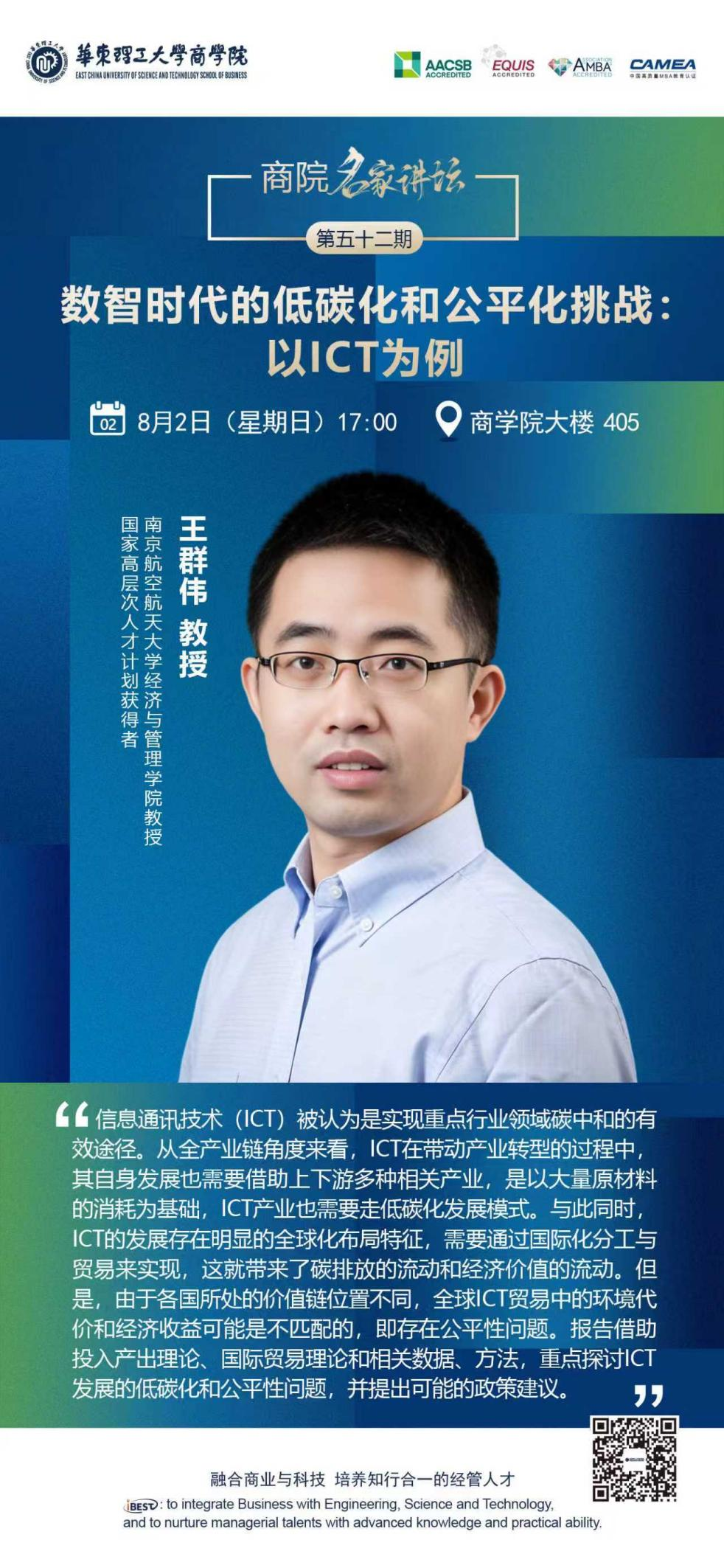
The 52nd "Business School Serial Lecture "
Title: Challenges of Low-Carbonization and Fairness in the Digital and Intelligent Era: The Case of ICT
Speaker: Qunwei Wang
Time: August 2nd, 2026 (Sunday) 17:00
Venue: 405, School of Business, East China University of Science and Technology
Organizer: School of Business, East China University of Science and Technology
Guest Bio:
Professor Qunwei Wang is a Professor at the School of Economics and Management, Nanjing University of Aeronautics and Astronautics, a recipient of the National High-Level Talent Program, and a recipient of the National Natural Science Foundation Outstanding Youth Science Fund. He has led over 10 research projects including a major project of the National Social Science Foundation. He has been selected for the Clarivate Analytics Global Highly Cited Researchers list and the Elsevier Chinese Highly Cited Scholars list. He has received awards including the Ministry of Education's Scientific Research Outstanding Achievement Award (Natural Science Second Prize, Humanities and Social Sciences Second Prize), the Jiangsu Provincial Science and Technology Award (Third Prize), and the Jiangsu Provincial Philosophy and Social Sciences Outstanding Achievement Award (First Prize, Second Prize, and Third Prize). He also serves as Associate Editor for multiple journals and as Chairman of the China Chapter of the International Society for Energy Transition.
Synopsis:
Information and communication technology (ICT) is considered an effective means of achieving carbon neutrality in key industries and sectors. From the perspective of the entire industrial chain, while ICT drives industrial transformation, its own development also relies on various upstream and downstream related industries, based on the consumption of large quantities of raw materials. The ICT industry therefore also needs to pursue a low-carbon development model. At the same time, the development of ICT exhibits pronounced characteristics of globalized spatial distribution, realized through international division of labor and trade, which entails flows of carbon emissions and economic value. However, due to the different positions of countries along the value chain, the environmental costs and economic benefits in global ICT trade may be mismatched, giving rise to issues of fairness. Drawing on input-output theory, international trade theory, and relevant data and methods, this report focuses on the low-carbonization and fairness issues in ICT development and proposes potential policy recommendations.